"Ride the Lightning" (full album) - Metallica

Showing posts with label Hi-Fi. Show all posts

Wednesday, February 17, 2016

Return to Unidad Park and the Filipino American History mural

After our Tustin trio of treats, we made our way to LA...

specifically to this part of town...

where we last visited last President's Day Weekend (2015).

We were back again for our family's holiday card photo shoot...

Monday, November 30, 2015

Unidad Park - return to the Filipino American history mural

[*The return of this year's Presidents' Day LA roadtrip]

After checking out the famed Music Box Steps in Silver Lake, we headed over to Historic Filipino Town (Hi-Fi)...passing by Bert's former college fave, Tommy's on Rampart...

which was a few short minutes away from a mural we last visited back in 2010 (post linked at the end)...

located in Unidad Park...

Saturday, April 24, 2010

Hi Fi - Part 4: The Filipino World War II Veterans Memorial

After checking out the FAL, we headed down to the Lake Street Community Center, the place in which the Filipino World War II Veterans Memorial is housed (227 N. Lake St. to be exact).
The memorial is next to the community center. That day there was a birthday party and there were many people hanging out there. Near the memorial, several teenagers milled about near the center's doorway. Other kids were skateboarding nearby. Here's one side of the mural...
Okay, I'm just typing off the top of my head here. I am trying not to have to do too many hyperlinks.
First slab - COLONY AND COMMONWEALTH.

The Philippine became a U.S. colony through the Treaty of Paris which ended the Spanish American War in 1898. After a "mock" battle between the United States and Spain, through secret negotiations, Spain handed over the Philippines and their other island posessions to the United States for $20 million. Rather than cede the country to the Philippines whom they considered an inferior power, Spain gave away "Las Islas Felipinas" to a new colonial master, the United States. Thus began an uneasy and  uncomfortable relationship between the U.S. and its new charges, the Philippines.

American occupation brought many changes in various aspects of Philippine life such as education where English was the lingua franca and the major language of instruction.  In order for the colonizers to convince their subjects that what they are teaching is good for them, it was at the expense of Philippine nationalism, in which their national heroes were vilified and their history suppressed.  This prcoess was known as "Benevolent Assimilation". In addition, they were taught that speaking their own dialect(s) was not as good as speaking English.  God forbid you have an accent and sound uncivilized or uneducated. President McKinley was famously known to have uttered that "Filipinos were unfit to govern themselves" and that it was the American's right to "uplift and Christianize" the Filipinos. He is depicted on the cover of Judge magazine (circa 1899) "baptizing" a Filipino who was portrayed as a crying black baby with wild hair.
Seen above is that same image which was used for the cover of the excellent "The Forbidden Book: The Philippine American War in Political Cartoons" by Abe Ignacio, Enrique de la Cruz, Jorge Emmanuel, Helen Toribio (2005,T'Boli Publishing, softcover). San Diego was host to the exhibit that accompanied the book in 2003 (or was it 2004?).  The exhibit ran briefly at the San Diego Museum of San Diego History. Bert and I were able to hear a lecture by Bay area historian, the late Helen Toribio who sadly passed away a few years later.

The American system of education and government was also the model for the Filipinos to emulate. Religion in the country changed, with the Americans bringing missionaries who evangelized the Filipinos in their beliefs. Food was also affected when canned goods(corned beef, SPAM and fruit salad, etc) imported from the U.S., especially during WWII  became status symbols. Indigenous Filipino values (kapwa, hiya, utang ng loob, and pakikisama) were hybridized with nearly three centuries of Spanish subjugation ("machismo", "marianismo", "amor proprio", "personalismo") and nearly a half century of American occupation which brought its own set of values (individualism, competition) which often clashed with the Filipinos' values of collectivism and togetherness.

The Commonwealth period refers to the era in which the Philippines was given a 10 year transitory period, beginning in 1934 after the passage of the Tydings-McDuffy Act which masqueraded as an "Independence Act" in the U.S. for the Philippines. The most damaging aspects of the Tydings-McDuffy Act were that it severely limited Filipino immigration to the U.S. to only 50 persons a year and automatically made Filipinos "aliens". Prior to this law, Filipinos were considered U.S. "nationals" (neither citizen nor alien). The road to Philippine independence was halted with the onset of World War II in 1941 after Manila was attacked by the Japanese on December 8, the day after the Pearl Harbor attack in Hawaii.
Detail of first slab:
Second slab - INVASION AND RESISTANCE:
After the bombing of the Philippines by Japan, Filipinos in the U.S. and in the Philippines were outraged and wanted to fight against Japan, which occupied the Philippines from 1942 to 1945. Due to their "alien" status, Filipinos in the U.S. were not allowed to join the military. As a result, President Franklin Delano Roosevelt changed the Selective Service Act in 1941 to allow Filipinos in the U.S. to join the military. Many of those Filipinos joined the U.S. army and were trained in California's West Coast. For more about these historic regiments, check out this link here. In the Philippines, the soliders joined the Philippine Scouts and USAFFEE (United States Armed Forces Far East).

Detail of second slab - Invasion and Resistance:
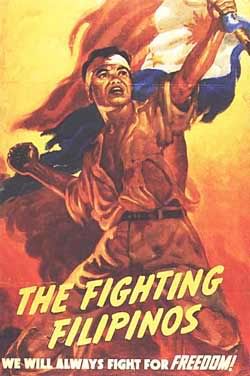
Original image of "The Fighting Filipinos" by Manuel Rey Isip, father of renowned graphic designer, Jordin Isip. The younger Isip's work has been seen on journals, magazines covers of major magazines like Time and Rolling Stone as well as album covers. I have a recreation of this poster hanging in our office at home.
(image from Philippine comic book artist Gerry Alanguilan's website, see the link here)

Third slab - BATAAN AND CORREGIDOR:
Bataan (pronounced "Bah-tah-an" not "bahtaahn") was an important place in WWII history. It was where the three month Battle of Bataan occured which was one of the most intense periods of the Japanese takeover of the Philippines in their effort to gain control in Asia. Until I looked up this informatin, I did not know that the Battle of Bataan was the largest surrender in Philippine and American military history.

Bataan is also associated with the infamous Bataan Death March in which thousands of Filipino and American POW's were forced to march for miles without food or water or be killed by the Japanese. The death toll, while not exact, has been estimated to be between six and eleven thousand men. Some war movies that reference the Philippines during World War II include "Back to Bataan" (1945) starring John Wayne and a very young Anthony Quinn playing the grandson of Andres Bonifacio (Philippine leader of the Kaptipunan),
as well as "Bataan" (1943) which starred Ricky Ricardo himself (okay, Desi Arnaz is his real name) playing a Filipino. Notice how they had Latinos/Hispanics playing Filipinos!
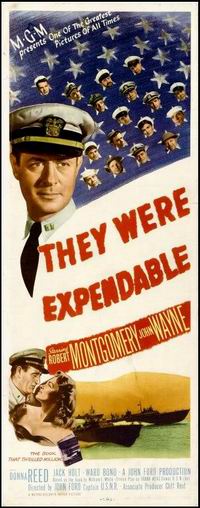
along with "They Were Expendable" (1945), which also starred John Wayne (again) and Robert Montgomery and the mother from "Father Knows Best", Donna Reed!
And more recently, "The Great Raid" (2005) starring Benjamin Bratt (yowza) and James Franco (the stoner in tv cult show, "Freaks and Geeks", Peter Parker's best friend in the Tobey Maguire "Spiderman" movies, and also in the stoner buddy flick, "Pineapple Express") which was about a POW camp in Cabanatuan, Philippines (hey, my brother was born in Cabanatuan!).

On a personal note, I actually have an older cousin on my dad's side who was named after General Douglas "I Shall Return" MacArthur. My cousin's name is Arthur but his nickname is "Mac". The American history books all hail McArthur but neglect to mention that he cheated on his wife with a Filipina mistress on the side.

Fourth Slab - SACRIFICE AND LIBERATION:
Detail of 4th slab:
Unbeknownst to them, despite their sacrifices during the war, Filipino American soldiers were to come home to a country that still did not respect their contributions in helping win the war against Japan.  American attitudes towards the Filipinos changed after World War II ended. Instead of being called "Little Brown Monkeys", Filipinos were the "Little Brown Brothers" (still a condescending term, in my opinion) and allies to the U.S.

Many of these soldiers were able to bring back their loved ones under the War Brides Act of 1945 and the Fiancees Act of 1946. The miserly immigration quota of 50 persons a year under Tydings-McDuffy was doubled to 100 persons a year after World War II with the exception of the War Brides and the Fiancees who were able to immigrate outside of the quota's limit.

In the U.S., the Filipino population increased little by little. In San Diego in particular, due to its  heave military presence, many of those same Filipinos who were trained at the Naval Training Center in Point Loma (now known as "Liberty Station", a gentrified and newly created community with commercialized mixed use spaces) as stewards for the white officers were able to settle down. Instead of bachelor societies, as demonstrated by their predecessors, the manongs who worked as manual laborers in the agricultural fields in the West Coast, these military families established themselves in areas of San Diego where it was legal for people of color to own homes, such as Southeast San Diego and the South Bay. La Jolla and Coronado were examples of cities where people of color were unwelcome to live unless of course, they were the hired help in the kitchens or as domestic help.

Fifth slab - EQUITY AND JUSTICE:
Although Filipinos fought valiantly side by side with Americans during World War II, these veterans
were not privy to same benefits as the American soldiers and whose benefits would soon be yanked. In 1946, their benefits were RESCINDED by the U.S. government. Many of these veterans did not have equal access to health care or even have a pension that they deserved. Instead of being treated as heroes, they were treated as "Second Class citizens". Since 1993, the Filipino Veterans Equity Bill has been introduced in to the U.S. House of Representatives and the U.S. Senate. Each year, the Bill is shot down. San Diego's own Congressman Bob Filner is also a big support of the Filipino Veterans Equity Bill and even went to jail after chaining himself to the White House in protest.

More on the Filipino Veterans Fairness Act here and here.

Detail of 5th slab:


Kagitingan means "Valor". There is also a holiday in the Philippines called "Araw ng Kagitingan" (Day of Valor) which commemorates the Fall of Bataan in World War II. My parents were still children during the days of World War II. My mother remembers Japanese soldiers randomly harassing Filipinos on the street, sometimes stringing them up by their feet and left to hang on trees. She told me that the flickering  fireflies at night were the ghosts of the Filipinos who were killed and tortured by the Japanese.
Another view of the memorial:
View near the community center:
Map of the Philippines on the memorial:
So that concludes our mini tour of sort of Historic Filipinotown in Los Angeles. It was a very eye opening experience reading about the contributions of Filipinos during World War II.  I wish we had a similar memorial in San Diego. We were left with a greater appreciation of our history as well as the shameful knowledge of the mistreatment of these veterans by the U.S.

Hopefully we can go to Hi-Fi again with our daughter and check  out PDUB Productions' Jeepney Tours. I think TC might like riding on a jeepney!

Next stop, a Filipino owned diner in Eagle Rock, the Oinkster!

Ube Shake here we come!

Friday, April 23, 2010

Hi Fi - Part 3: Filipino American Organizations

[Original trip was 3 weeks ago - Part 3 of a 4 part series on Historic Filipinotown in Los Angeles]

Before I begin this post, here is  an updated map of Hi-Fi we took from the dusty porch of the Filipino American Library(FAL)...
One of our stops was the Filipino Christian Church
301 North Union Avenue,
Los Angeles, California 90026
(213) 483-5821

Ha ha, you can see the reflection of my stanky foot in the photo! I took this while we were in the car! The last time I was were was in 1996 with TORC. We were at an Filipino American educators conference in LA and decided to ditch some of the afternoon workshop session and drive over to Tatak Pilipino (a now defunct store that sold Philippine crafts and clothing) and hit up some of the Filipinotown spots like the Mural, the Filipino Christian Church and Jeepney Grille (now defunct as well). Bert and I were also here with Supe and Lois Lane back in 1996.
According to the church's website:

"The humble beginning of what is to be the Filipino (Disciples) Christian Church in Los Angeles goes back to the early turn of the 20th century. The introduction of Protestant Christianity in the Philippines came after the Americans defeated the Spanish Armada at the Manila Bay. Mission Boards in the US sent their missionaries almost immediately to the islands. However, the first Disciples missionaries came in 1902. To hasten evangelization of the Philippines, the mission board decided to divide the effort by denominations. The Disciples were given the Ilocos region.

In 1928, the World Sunday School convention was held in Los Angeles. Delegates from the Disciples in the Philippines were chosen to represent the country. Among them were Rev. Sylvestre Morales and Felix Pascua."

My notes:
 1) The Rev. Sylvestre Morales was the father of the late Uncle Royal Morales (seen previously on the Filipino American History mural on Beverly Blvd). Uncle Roy was wearing a "Manong Bagoong baseball cap when we first met him. He was also proud to be Ilocano. As mentioned from the passage above, the Disciples missionaries targeted the Ilocos region of the Philippines to spread their faith.
Here is a photo of Uncle Roy. He was recognizable with his long goatee and his Fu Manchu moustache. He passed away of a heart attack at the age of 68 in 2001. He was a social worker who helped troubled youth, was one of the founders of SIPA (Search to Involve Pilipino Americans) in 1972 and was one of UCLA's most popular lecturers in the Asian American Studies department with his Pilipino American Experience class.
He was also author of the book, "Makibaka - The Pilipino American Struggle" (1974, Mountainview Publisher, out of print Hardcover). The book photos below are from my personal collection. I found this book at a used bookstore downtown.
As luck would have it, it was signed by Uncle Roy himself!  Thanks Dr. F. N. Waldrop!!!! This is MINE now!
This was the "author's photo" on the inner left dust jacket flap. If you look closely, you can see the original price of the book in red, $5.99!!! I bought it used for maybe $10-15. For those of you that don't know, I collect books on Filipino American history, poetry and literature. This book is one of the holy grails of Filipino American books, ranking among the top which includes the landmark UCLA publication, "Letters from Exile - An Introductory Reader on the History of Pilipinos in America" by Jesse Quinsaat, et al in 1976. Another note - Jesse Quinsaat is a Filipino American lawyer who still practices law; his office is in downtown San Diego.
This was the 1998 2nd reissue of Morales' book, "Makibaka 2", published by Crown Printers from the Republic of the Philippines. It was only released as a softcover edition.
The reissued edition contains several appendices which were not in the original. I actually paid for this book through eBay and then sent it to Uncle Roy while he was still alive. He was quite gracious as he remembered me from my involvement in FANHS. He signed my book then mailed it back to me. This was the inscription he wrote for my book on March 1, 1999.
And here is the "updated" author's photo. I paid $24.50 for this edition.
Moving right along...
2) The majority of the people in the Philippines are of the Catholic faith, no thanks to Spanish Colonization. The remaining religious denominations are Christian, Baptist, Pentecostal with a tiny percentage being Muslim (mainly in the southernmost region, Mindanao). More about Religion in the Philippines here.
Although the church was founded in 1928, its location varied throughout the years until 1950 when the Church bought the building on Union Avenue (which was the former Union Avenue M.E. Church). It was the first religious organization founded in L.A. to focus on the spiritual needs of Filipinos under the auspices of the Disciples of Christ (DOC).

"Built in 1895, the church struction was rebuilt in 1909, designed by Jeffrey Van Trees (Straus) & Moella...and was a...combination of styles - Gothic, English Revival and Craftsman. The foundation and lower potion of the walls are made of cement and bricks, with its distinguished heavy wooden floor, hand fashioned wooden pews and antique stain glass window depicting Jesus Christ and angels herding a flock of sheep".

(info taken from p. 222 of the revised edition of Makibaka 2 by Royal F. Morales; article, "Filipino Christian Church: the Making of an Histoical Cultural Monument in Los Angeles,CA, USA"

"In recent times - 70s to the present - the Church has been the focal place of community activism and organizing along Filipino American issues and concerns. It is the home base of the Legionarios del Trabajo of the Filipino old timers. The organizing and development of community based organizations were accomplished in the church facility which include the following groups:
SIPA, Optimist Club Summer Youth School, PARRAL (precursor to the Filipino American Library), FANHS Los Angeles Chapter, and a meeting place for the fellowship for the Veterans Sons of Pacay, and Annac ti Batac of So. Calif."  (p. 223 of Makibaka 2)
I remember both of my previous visits, there was no gate and we were able to walk into the church easily. We were warmly greeted by several folks there. Everyone was friendly and excited that we came to visit from San Diego. One of them had the same last name as Tatonka (our friend who loves to give the "finger" in photos). Turns out that the guy is distantly related to him because he ended up contacting him later that year. This visit however, we were locked out. We could hear the choir practicing inside though.

In 1998, the church became Historical Monument # 561, becoming the first Filipino historical landmark in the City of Los Angeles.
Detail of stained glass window on the south side of the church:
Mural  near Rosemont Elementary School while on our way to our next destination in Hi-Fi:
Graffiti somewhere along the way...
We wanted to check out the Filipino American Library, which was next to this organization, the Filipino American Serviceds Group, Inc. (FASGI)...which is "a community based 501 (c)(3) nonprofit social service agency. Founded in Los Angeles, California in 1981, it focuses on promoting the physical health and mental wellbeing of underserved low-income seniors. It provides much needed services through programs that address health issues, homelessness, and social challenges. FASGI aims to improve the quality of life of all members of the community in Historic Filipinotown and the Greater Los Angeles Area" (info taken from their website)

FASGI
Park View Transitional Housing
135 N. Park View St.
Los Angeles, CA 90026
Actually, both places were closed that afternoon. When you face the building for FASGI, the FAL is to the right. Both are in small cottage homes. This one is tricked out to look like a nipa hut with all the bamboo accents. Turns out that it is open by appointment only and in the process of moving.

Filipino American Library
135 N. Park View St.
Los Angeles, CA 90026
The origin of the FAL was borne from the brainchild of Helen Agcaoli Brown (who was also featured in the Filipino American History mural). She founded the Pilipino American Reading Room and Library (PARRAL) in 1985. It was once housed in the basement of the Filipino Christian Church. Later, PARRAL relocated to Luzon Plaza near the now defunct Aristocrat of Manila restaraunt (which now houses Kapistahan Grill) on Temple Street. PARRAL was also renamed as FAL. The website doesn't indicate when the FAL moved to this location, however it also states that the FAL is in the process of moving.

This is cool - check out this Interactive Timeline of Filipino American History here, courtesy of the FAL website.

Despite the FAL being closed, we tried the door to the covered porch and what do you know, it was open. Only the porch though. The building itself was closed. There were book cases with all kinds of pamphlets in English and Tagalog. There was also a thick layer of dust on these open bookcases.
Here is a shot of some of the pamphlets, many of them offering services for health, information about voting, and social services.
We also picked up an updated map of Historic Filipinotown. The one from the internet was hard to read. The text in the boxes was microscopic. Like WTF. But this one was a little more clear and had updated info on it.
Not visited:

153 Glendale Boulevard, 2nd Floor
Los Angeles, California 90026
Phone: (213) 250-4353
http://www.pwcsc.org/

"Pilipino Workers' Center was formed in 1997 and provides services and resources to help Pilipino workers and their families while organizing for long-term change.


PWC also serves as a research institute that focuses on the latest data, statistics and situation of Filipino workers and immigrants here in the United States, as well as a resource for information on the Philippines."

Search to Involve Pilipino Americans (SIPA)
Temple Gateway Youth & Community Center
3200 West Temple Street
Los Angeles, CA 90026-4522
Tel: 213-382-1819
Fax: 213-382-7445

http://www.esipa.org/

"For over 36 years [founded in 1972], Search to Involve Pilipino Americans (SIPA), headquartered in multi-ethnic Historic Filipinotown, has served this impoverished neighborhood as well as the greater Los Angeles Filipino American community with mission-fueled passion and relatively little fanfare.


SIPA continues to provide health and human services as well as community economic development and arts/cultural programs to the now diverse, multi-ethnic youth and families residing in the area as well as Filipino Americans all over Los Angeles County." (from their webiste)

One of our good friends interned with SIPA during grad school. The Executive Director, Joel Jacinto is a really cool guy. I've met him a few times at various Filipino American educator events and more recently at the FANHS National Conference in Hawaii (2006).

Filipino American Community of Los Angeles (FACLA)
1740 West Temple Street
Los Angeles, CA 90026

So we didn't get a chance to check these places out this time. We were trying to be efficient by visiting whatever we could find in the numerical sections of the map. Not everything was that close together.

There were also a few more churches listed on the map (here's the older version here) but we chose to visit the FCC because it had the specific word "Filipino" in the title.

Up next, the Filipino World War II Veterans Memorial...

Sunday, April 18, 2010

Hi Fi - Part 2: Filipino American Businesses


This is the Hi-Fi map we downloaded off the internet. We ended up getting a bigger (more readable)  and updated map from our quick jaunt to the Filipino American Library (to be covered in a separate post).

Our road trip was not just about food but also about Filipino American history. As an avid collector of Filipino American history books, literature and poetry, I tend to seek out these types of sights/trivia in most of the cities that we visit...Call me nerdy or whatever, but I am into this!

We drove by most of these places and stopped at a few to snap the photos. In a future visit, we will check out some of the restaurants and eateries.
My Mom's Bake Shop (ooh, I see a "Pinoy BBQ" sign there)
1606 Beverly Blvd
Luzon Plaza
1925 West Temple Street.
Luzon Plaza building
Kapistahan Grill
1925 West Temple Street, Suite 103

This used to be "Aristocrat" (a Philippine restaurant) which was on the second floor. I remember eating there in May 1991 with Bert, Astroboi and Thane. We were there for N's graduation from USC! The food was good! It was the fanciest Filipino restaurant any of us had even been to. One of the more memorable dishes was fish cooked in a clay pot with Philippine vegetables.
Temple Plaza
2452 West Temple Street
Businesses in Temple Plaza: Macapagal Optical and Nanay Gloria's Market...
as well as Temple Seafood Market. I'm sure this place is a godsend for those who need to get their fix of Filipino ingredients and supplies. You can't find that shit at Ralphs or Vons you know!
Bahay Kubo
2330 West Temple Street

I think I want to try this place next time we cruise up! "Bahay Kubo" is a Philippine thatched hut (there's one in the fish tank in "Finding Nemo" courtesy of one of the Filipino animators who worked on the film, Ricky Nierva). It is also the name of a Philippine folk song which describes a nipa hut surrounded by all kinds of native vegetables.
Remy's on Temple
2126 West Temple Street
I checked on Yelp and the last review was from 2008. I don't think this place is still open (see the "Available" sign?). It was formerly an art gallery. Their website doesn't work either.
Tribal Cafe
1651 West Temple Street
This was some sort of juice bar and casual eatery.
This is not a Filipino owned business, but I just had to snap this shot of this McD's on the corner of Temple and Alvarado. I'd never seen a McD's with "arches" before!
Not shown:
318 Glendale Blvd

Actually, we passed this up and I didn't have the camera ready. There were tons of Uncles and Aunties hangin' out over there. Looks like a happenin' place for the over 60 set. Seriously, we would go to this place! I read that this place was founded in 1977 and is the oldest existing Filipino American restaurant in the area.

5050 West Sunset Blvd.

Didn't get a chance to see this...Heard they have the best noodles here and is one of the best turo-turo ("point point") places in L.A.

Kabayan Pinoy (the map says "Kabayan", the LA yellow pages say "Kaban" and the google search turns up "Kababayan"). I think the actual name is "Kaban Pinoy"
3253 Beverly Blvd.

Missed this one completely!

Next up...Filipino American organizations...