
The memorial is next to the community center. That day there was a birthday party and there were many people hanging out there. Near the memorial, several teenagers milled about near the center's doorway. Other kids were skateboarding nearby. Here's one side of the mural...
Okay, I'm just typing off the top of my head here. I am trying not to have to do too many hyperlinks.First slab - COLONY AND COMMONWEALTH.
The Philippine became a U.S. colony through the Treaty of Paris which ended the Spanish American War in 1898. After a "mock" battle between the United States and Spain, through secret negotiations, Spain handed over the Philippines and their other island posessions to the United States for $20 million. Rather than cede the country to the Philippines whom they considered an inferior power, Spain gave away "Las Islas Felipinas" to a new colonial master, the United States. Thus began an uneasy and uncomfortable relationship between the U.S. and its new charges, the Philippines.
American occupation brought many changes in various aspects of Philippine life such as education where English was the lingua franca and the major language of instruction. In order for the colonizers to convince their subjects that what they are teaching is good for them, it was at the expense of Philippine nationalism, in which their national heroes were vilified and their history suppressed. This prcoess was known as "Benevolent Assimilation". In addition, they were taught that speaking their own dialect(s) was not as good as speaking English. God forbid you have an accent and sound uncivilized or uneducated. President McKinley was famously known to have uttered that "Filipinos were unfit to govern themselves" and that it was the American's right to "uplift and Christianize" the Filipinos. He is depicted on the cover of Judge magazine (circa 1899) "baptizing" a Filipino who was portrayed as a crying black baby with wild hair.

The American system of education and government was also the model for the Filipinos to emulate. Religion in the country changed, with the Americans bringing missionaries who evangelized the Filipinos in their beliefs. Food was also affected when canned goods(corned beef, SPAM and fruit salad, etc) imported from the U.S., especially during WWII became status symbols. Indigenous Filipino values (kapwa, hiya, utang ng loob, and pakikisama) were hybridized with nearly three centuries of Spanish subjugation ("machismo", "marianismo", "amor proprio", "personalismo") and nearly a half century of American occupation which brought its own set of values (individualism, competition) which often clashed with the Filipinos' values of collectivism and togetherness.
The Commonwealth period refers to the era in which the Philippines was given a 10 year transitory period, beginning in 1934 after the passage of the Tydings-McDuffy Act which masqueraded as an "Independence Act" in the U.S. for the Philippines. The most damaging aspects of the Tydings-McDuffy Act were that it severely limited Filipino immigration to the U.S. to only 50 persons a year and automatically made Filipinos "aliens". Prior to this law, Filipinos were considered U.S. "nationals" (neither citizen nor alien). The road to Philippine independence was halted with the onset of World War II in 1941 after Manila was attacked by the Japanese on December 8, the day after the Pearl Harbor attack in Hawaii.


After the bombing of the Philippines by Japan, Filipinos in the U.S. and in the Philippines were outraged and wanted to fight against Japan, which occupied the Philippines from 1942 to 1945. Due to their "alien" status, Filipinos in the U.S. were not allowed to join the military. As a result, President Franklin Delano Roosevelt changed the Selective Service Act in 1941 to allow Filipinos in the U.S. to join the military. Many of those Filipinos joined the U.S. army and were trained in California's West Coast. For more about these historic regiments, check out this link here. In the Philippines, the soliders joined the Philippine Scouts and USAFFEE (United States Armed Forces Far East).

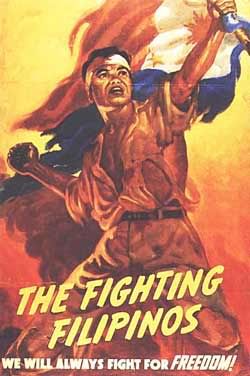
(image from Philippine comic book artist Gerry Alanguilan's website, see the link here)
Third slab - BATAAN AND CORREGIDOR:

Bataan (pronounced "Bah-tah-an" not "bahtaahn") was an important place in WWII history. It was where the three month Battle of Bataan occured which was one of the most intense periods of the Japanese takeover of the Philippines in their effort to gain control in Asia. Until I looked up this informatin, I did not know that the Battle of Bataan was the largest surrender in Philippine and American military history.
Bataan is also associated with the infamous Bataan Death March in which thousands of Filipino and American POW's were forced to march for miles without food or water or be killed by the Japanese. The death toll, while not exact, has been estimated to be between six and eleven thousand men. Some war movies that reference the Philippines during World War II include "Back to Bataan" (1945) starring John Wayne and a very young Anthony Quinn playing the grandson of Andres Bonifacio (Philippine leader of the Kaptipunan),

as well as "Bataan" (1943) which starred Ricky Ricardo himself (okay, Desi Arnaz is his real name) playing a Filipino. Notice how they had Latinos/Hispanics playing Filipinos!

along with "They Were Expendable" (1945), which also starred John Wayne (again) and Robert Montgomery and the mother from "Father Knows Best", Donna Reed!
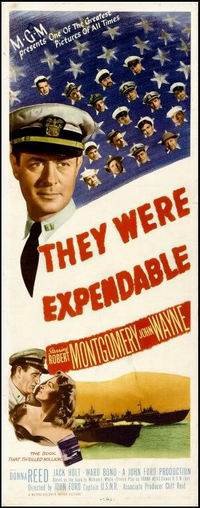
And more recently, "The Great Raid" (2005) starring Benjamin Bratt (yowza) and James Franco (the stoner in tv cult show, "Freaks and Geeks", Peter Parker's best friend in the Tobey Maguire "Spiderman" movies, and also in the stoner buddy flick, "Pineapple Express") which was about a POW camp in Cabanatuan, Philippines (hey, my brother was born in Cabanatuan!).

On a personal note, I actually have an older cousin on my dad's side who was named after General Douglas "I Shall Return" MacArthur. My cousin's name is Arthur but his nickname is "Mac". The American history books all hail McArthur but neglect to mention that he cheated on his wife with a Filipina mistress on the side.


Unbeknownst to them, despite their sacrifices during the war, Filipino American soldiers were to come home to a country that still did not respect their contributions in helping win the war against Japan. American attitudes towards the Filipinos changed after World War II ended. Instead of being called "Little Brown Monkeys", Filipinos were the "Little Brown Brothers" (still a condescending term, in my opinion) and allies to the U.S.
Many of these soldiers were able to bring back their loved ones under the War Brides Act of 1945 and the Fiancees Act of 1946. The miserly immigration quota of 50 persons a year under Tydings-McDuffy was doubled to 100 persons a year after World War II with the exception of the War Brides and the Fiancees who were able to immigrate outside of the quota's limit.
In the U.S., the Filipino population increased little by little. In San Diego in particular, due to its heave military presence, many of those same Filipinos who were trained at the Naval Training Center in Point Loma (now known as "Liberty Station", a gentrified and newly created community with commercialized mixed use spaces) as stewards for the white officers were able to settle down. Instead of bachelor societies, as demonstrated by their predecessors, the manongs who worked as manual laborers in the agricultural fields in the West Coast, these military families established themselves in areas of San Diego where it was legal for people of color to own homes, such as Southeast San Diego and the South Bay. La Jolla and Coronado were examples of cities where people of color were unwelcome to live unless of course, they were the hired help in the kitchens or as domestic help.

Although Filipinos fought valiantly side by side with Americans during World War II, these veterans
were not privy to same benefits as the American soldiers and whose benefits would soon be yanked. In 1946, their benefits were RESCINDED by the U.S. government. Many of these veterans did not have equal access to health care or even have a pension that they deserved. Instead of being treated as heroes, they were treated as "Second Class citizens". Since 1993, the Filipino Veterans Equity Bill has been introduced in to the U.S. House of Representatives and the U.S. Senate. Each year, the Bill is shot down. San Diego's own Congressman Bob Filner is also a big support of the Filipino Veterans Equity Bill and even went to jail after chaining himself to the White House in protest.
More on the Filipino Veterans Fairness Act here and here.
Detail of 5th slab:


Kagitingan means "Valor". There is also a holiday in the Philippines called "Araw ng Kagitingan" (Day of Valor) which commemorates the Fall of Bataan in World War II. My parents were still children during the days of World War II. My mother remembers Japanese soldiers randomly harassing Filipinos on the street, sometimes stringing them up by their feet and left to hang on trees. She told me that the flickering fireflies at night were the ghosts of the Filipinos who were killed and tortured by the Japanese.


So that concludes our mini tour of sort of Historic Filipinotown in Los Angeles. It was a very eye opening experience reading about the contributions of Filipinos during World War II. I wish we had a similar memorial in San Diego. We were left with a greater appreciation of our history as well as the shameful knowledge of the mistreatment of these veterans by the U.S.
Hopefully we can go to Hi-Fi again with our daughter and check out PDUB Productions' Jeepney Tours. I think TC might like riding on a jeepney!
Next stop, a Filipino owned diner in Eagle Rock, the Oinkster!
Ube Shake here we come!


No comments:
Post a Comment