"Ride the Lightning" (full album) - Metallica

Showing posts with label universities. Show all posts

Wednesday, October 13, 2010

Other murals at the SFSU Cesar Chavez Center

In addition to the Filipino Community Mural at the SFSU Cesar Chavez Center were other murals on the other side and inside the center. So, on the back side, you have the murals for Cesar Chavez and Malcom X.
 
There are a few more murals inside but we didn't go in (although in hindsight, we should have) because we I wanted to get to Thane's place and get to Ferry Building for lunch.

(Info taken from SFSU's Cesar Chavez Student Center website:

"The Cesar Chavez mural was dedicated on May 5, 1995, about seven months after the San Francisco State University Student Union was renamed after Chavez.

The mural is divided into four parts: Chavez, the United Farm Workers logo, the flaming torch, the dove, and “Grapes of Wrath.”

Chavez is shown in the center of the mural, and is honored because of his contributions to the farm workers movement of fair pay and working conditions. In 1962 he founded the National Farm Workers Association, which would later merge with the Filipino Agricultural Workers Organizing Committee to become the United Farm Workers of America.

The UFW logo of an eagle is shown in the background of the mural to honor the organization and what the image means to so many. The eagle was taken from the Mexican flag.

The UFW was the first successful farm workers union in U.S. history with a membership of 100,000 at its peak. Chavez and his brother Robert originally designed the logo with the goal of creating an image that would be easily identifiable and reproducible by farm workers. Artist Andy Zermeno, Chavez’s friend, produced its final design.

The colors of the logo were chosen to represent hope (white), struggle of workers (black) and sacrifice (red). Among many farm workers of Mexican descent, the eagle image is very meaningful and recognizable. The logo has become a symbol of the Chicano Rights movement.

Chavez holds a torch in the mural, which represents his inspirational leadership and what he endured in fighting for workers’ rights.

In his left hand he holds a dove, which symbolizes his belief in non-violent resistance. Chavez drew inspiration from Jesus, Gandhi and Martin Luther King, Jr. and exuded his peaceful stance through fasts and marches. In 1972 he carried out a 24-day, water-only fast and in 1988, a 36-day fast. In 1966 he marched from Delano to Sacramento and in 1969 through the Imperial and Coachella valleys to the border of Mexico.

Also present in the mural are the “Grapes of Wrath,” which resemble skulls to signify the harmful effects of pesticides on farm workers. The grapes also represent the first consumer boycott of the UFW, the 1965 Delano strike. The small boycott evolved into a public five-year strike against California table grapes.

The lead artist on the Cesar Chavez mural was Carlos “Cookie” Gonzalez. The mural is located in the Malcolm X Plaza."

(info below taken from the same website as before):

"To make the Malcolm X Plaza complete, a corresponding mural was dedicated to Malcolm on May 15, 1996 beside the Cesar Chavez mural.


The quote, “By any means necessary” on the bottom of the mural and other images represent Malcolm’s progression as a spiritual leader. The mural also has a theme of day and night, represented by a moon and sun in each upper corner, to symbolize Islam. (That is one of my favorite quotes)

The image of Malcolm in the upper left corner is based on a picture of the leader addressing a Harlem rally in support of integration in Birmingham, Alabama on May 14, 1963.

The other image of him, in a dashiki, is based on a picture taken in Accra, Ghana on April 11, 1964 while he was visiting the W.E.B. DuBois Center for Pan African Studies. The picture was taken after his pilgrimage to Mecca and captures his dignity. He is shown with a book in his hand, to represent the importance of self-education, and a ring on his finger, with the Arabic spelling of Allah, indicating his ability to read Arabic.

An image of the continent of Africa engulfing the United States is shown in between the images of Malcolm, and is based on the Mercator projection, which conveyed the relative size of Africa compared to the U.S. It also reflects the international aspect of Malcolm’s teaching. He passionately argued that African Americans need to internationalize the struggle, as their struggle is the African struggle and vice versa.

A shield and spear appear in the lower left corner to symbolize the warrior, freedom fighter and militant. The words, “ Our objective is complete freedom justice and equality,” another quote of Malcolm’s, is written above a silhouette of supporters.

The intent of the mural, along with the dedication of the plaza, was to honor, promote and understand the teachings of Malcolm including: his legacy of political, spiritual, economic, and social philosophy; the fact that he was an independent thinker who contributed to the movements for civil and human rights in the 1960s; and regardless of status, everyone can speak and act for social change, justice, and freedom for all.

The painting was the second Malcolm X mural for SF State. The first, completed in May 1994, drew public outcry from Jewish students and gained nationwide media attention for being what some thought as anti-semitic. The controversial mural depicted Malcolm amongst dollar signs, Stars of David, skulls, and the words “African Blood.” In response to protests, the mural was sandblasted and permanently removed.

The current, and not at all controversial, Malcolm X mural was painted by SF State students Eric Norberg and Kamau Ayubbo. Malcolm’s widow, Dr. Betty Shabazz, was an honorary speaker at the dedication ceremony. 

Here's TC and Bert goofing off in Malcolm X Plaza...

Here's Bert pretending to be a drunkass student...

That is seriously an empty bottle of whisky on the ground. Nice.

Bert thought it would be funny to pose like this. Way to go! Great role model to our daughter there. The joke was on him because he ended up getting bird poo all over his jacket; the poo was on the concrete bench! Yuck!
More info on these murals and the other ones here

Sunday, October 10, 2010

SFSU - The Filipino Community Mural at the Cesar Chavez Center

[My notes are in yellow throughout]

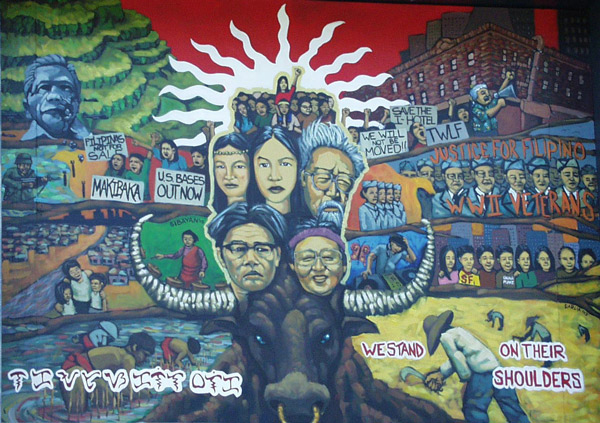
The mural wasn't so hard to find...it's located on the bookstore side of the Cesar Chavez Center. When you face the bookstore, the mural is to your left and it is about two stories off the ground, not at eye level like I thought it would be.

(info below taken from an article on SFSU's website, "Students Unveil Filipino Community Mural" (April 4, 2003):

"SFSU made history today when students unveiled the Filipino Community Mural at the Cesar Chavez Student Center. The mural is the first in the California State University system to depict Filipino history.

The mural is a collaborative effort painted by 200 students, faculty, staff and community members, with lead artists James Garcia and Christina Carpio. It was permanently installed on the north plaza outside the Cesar Chavez Student Center, joining memorials to Cesar E. Chavez, Malcolm X, Rigoberta Menchu, Richard Oakes, Jack Adams and Rosa Parks...

"The mural depicts community, the Filipino struggle for independence, struggles of Filipinos in the United States, solidarity and Filipino history. Planning for the mural began four years ago by a student who wanted to honor Filipinos in the same way other ethnic groups are recognized on campus.
[You can see the sign, "U.S. Bases Out Now" which refers the the "special" relationship between the Philippines and the U.S. due to the 1947 Military Bases Agreement in which post WWII Filipinos in the Philippines were recruited for the U.S. Navy to specifically work as stewards (or glorified servants). Up until th 1970's when ascending the ranks became less discriminatory due to then Chief of Naval Operations Elmo Zumwalt's "Z-Grams", Filipinos, along with blacks and other minorities were relegated to lower ratings.

The sign "Filipinas Not For Sale" makes me a bit angry and emotional. If it weren't for the poor economy of the Philippines, many of these women wouldn't feel forced to work as prostitutes or work away from their homeland as OCW (overseas contract workers). Many women work as domestic help in Europe, the U.S. and in the Middle East. Although their salary is probably more than what they would earn back in the Philippines, these women are really underpaid and sometimes abused or taken advantage of by their employers. In addition, sex trafficking, along with child slavery and prostition is still a big problem in the Philippines.

"Makibaka" was one of the rallying cries during the 1970's; it means "Struggle" in Tagalog. The full phrase was, "Makibaka! Huwag matakot!" (Struggle! Don't be afraid!) and was even made into a song by 1970's Filipino American band (their sound is reminiscent of Santana), Dakila.

You can see San Francisco Filipina American activist, Violet "Bullet" Marasigan, next to the gray haired late poet/community activist Al Robles. At the lower left is labor activist Philip Vera Cruz of the UFW.

(info below taken from SFSU's webpage on "Cesar Chavez Center - Murals"):

"With assistance from over 200 students, faculty and community members, the Filipino Community Mural was dedicated on April 4, 2003 after four years of work.

The mural is divided into four sections: solidarity, community, struggle in the Philippines and struggle in the United States. It represents both ancient times and the ongoing importance placed on community and heritage. “We Stand on their Shoulders” is written in ancient Philippine script at the bottom of the mural to recognize that today’s Filipino community stands tall because of the achievements of their ancestors. [CC's notes: the script is known as "Baybayin"]

In representation of solidarity, a sun rises in the background of the mural, symbolizing the Philippine Revolution against Spanish colonization. The rays of the sun represent the numerous regions that resisted the Spanish domination for almost 400 years. People stand linked arm and arm, in front of the sun, to represent solidarity with all people of color. A Filipino family, the center of the culture’s existence, is also shown.[there are 8 rays in the Philippine sun flag design]

Community, an important part of the Filipino culture, is represented in the mural through important figures Purmassuri, Lorena Barros, Al Robles, Violeta A. Marasigan, and Philip Vera Cruz. These icons of the culture paved the way for future generations through their bravery, dedication and persistent hard work.[Al Robles recently passed away last year. Bert, Superman and I had the pleasure of meeting Alat UCLA in back 1996 for a Filipino American studies conference. His poetry book, "Rappin' With One Thousand Carabao in the Dark" was released that year and I had him sign my copy.]

The struggle in the Philippines is a component of the mural so that the Filipino-American community will not overlook it today. A carabao, a water buffalo, represents the Filipino people who are tillers of the land. Peasants are shown to represent those who continue to struggle for the rights of their lands. An image of a woman playing Kulintang emphasizes importance of music in the Filipino indigenous culture, and students and workers are shown fighting for a dignified way of life.

The right side of the mural shows the struggle in the United States through pictures of struggle from the Filipino-American community. The top image is of the International Hotel and those displaced through eviction. Veterans and nurses are shown to represent the struggle for equality and fair pay. The DJ, balancing out the women playing Kulintang, and the SF State students represent the life and trial of the young Filipino-American culture. Lastly, the farm workers are shown planting the seeds from which the roots of the community are grown.

Below the mural are the windows/doors to the bookstore. Everything that had the SFSU logo on it was 25% off that day, so hell to the yeah, I bought a shirt (Go Gators!) to wear on College T-Shirt Fridays for work. Actually, my shirt is so cool - it says, "SFSU - The School that Rocks!" with a kickass guitar and flames right in the middle of the shirt!

To view a larger version of the mural click here. (btw, not my photo)

For more info on this mural and the others at the Cesar Chavez Center, click here.

San Francisco State University

Now you may be wondering, why SFSU?

There were several reasons...

One important reason was that during five tumultuous months in late 1968 to early 1969, SFSU was the site of the Third World Strike. The Third World Liberation Front (TWLF), consisting of various factions of African American, Chicano American, Native American and Asian American groups challenged the traditional university system and demanded that the university offer ethnic studies classes and hire Third World professors.

This strike led to the formation of the United States' first and largest Ethnic Studies department, which is still going on strong today, especially with young and dynamic Filipina American professors like Dr. Allyson Tintiangco-Cubales and Dr. Dawn Mabalon, and led by veteran professors Dr. Dan Begonia and Dr. Daniel Gonzales.

Here are a couple of videos detailing the Third World Strike. In this first one, there is also a brief mention of the International Hotel (detailed briefly in my previous post at the SWC book signing):

This next video was produced by PACE (Pilipino American Collegiate Endeavor), one of the first Filipino American student organizations formed during the Third World Strike. I like this video because it's short and to the point but also because it encourages students to know their roots while giving them a sense of the history that preceded them.

The campus was deserted, being a weekend and all. We parked at this rather old parking structure near Park Merced. I'm not sure which building this was...

The campus was so quiet...and it smelled really clean especially since it rained earlier that morning.

Today also happened to be Alumni Day - come to think of it, we did see some older folks walking with a purpose on campus. The alumni reception was going to be our destination, the Cesar Chavez Center.

Here is that famous first, the building for Ethnic Studies and Psychology.

A cool bench we saw while walking around...

A cool sculpture...

Statue of a huge head...

Looks like their old library is going to get an overhaul and become bigger and better.

You are HERE!

Bert and I feel it's important for our daughter to be on college/university campuses. Higher education is important to both of us. Like his siblings, Bert was a first generation college student. Our parents' generation only went to college if they were privileged enough or if their family sacrificed. In my case, my mother went to the University of Santo Tomas, a Jesuit university in the Philippines that predates Harvard. She was fortunate that her parents saved enough money for both her and her brothers to attend university. My father's college education came later during his retired years after having served 23 years in the US Navy. We feel that education will open doors of opportunity for TC, so it's a given that one day she will attend a four-year university.

I particularly chose SFSU since it has a rich history in which current students are reaping the benefits of those who fought for these rights and demands back in the 60's. As a second generation Filipina American, I feel that our daughter should know places of interest like SFSU (among others: UCB, UCLA, SDSU). So even though she may not completely comprehend its importance or fully appreciate these visits masterminded by her mother, I'd like to think that the history that I teach her and the places that we take her stick in her mind and give her more confidence and knowledge about our history.

Another reasons why we went here also ties in with October being Filipino American History Month. SFSU is home to a particular mural I wanted all of us to see...

Next up, the murals at the Cesar Chavez Center...

Tuesday, June 22, 2010

The University of Toronto

[Note - I felt like Rumpel Stiltskin when we got back to San Diego]. One of the biggest things was that we missed an EARTHQUAKE that weekend! It was one of the aftershocks of the Easter earthquake in Ocotillo. No wonder one of my Pez dispensers was on the family room floor (knocked down from above our TV). One of my Tick figures (Chairface Chippendale to be exact) was also on the floor of our library loft. Several picture frames were also askew. At least our house was still standing!]

After the Bata, we decided to check out the nearby University of Toronto...Their motto means, "As a tree through the ages"...
You are Here!
Really pretty wrought iron fence...
I liked the "Skull Fist" sticker!
The Max Gluskin House, which was built in 1898. I thought it looked cool next to that more modern building.
While walking along St. George St, we saw some food trucks...
There was also construction going on...this was near the Rotman School of Management.
More food carts...We noticed there were A LOT of hot dog carts.
Plastered all over the telephone poles and bulletin boards were various campus events. I thought this was quite noteworthy. Note the warning which says that "idjits will be offended"! I would have enjoyed this presentation!
One of the beautiful buildings on campus...
Something was happening across the ways...
This building is University College on King's College Circle next to a grass area known as Front Campus.
Turns out there was a "convocation" (that's the formal and fancy way to say "graduation" for us American ig'nants). That green domed building is Convocation Hall.
(from wikipedia's entry on "Convocation Hall")

"Convocation Hall is a domed rotunda on the grounds of the University of Toronto in Toronto, Ontario, Canada. Designed by Pearson and Darling and completed in 1907, it was inspired by the grand theatre of Sorbonne and the Sheldonian Theatre at Oxford.[1] The building primarily serves as the venue for the annual convocation ceremonies..."
It was really cool kind of mingling in with the grads. There were lots of happy faces (parents, friends and the graduates themselves). The vibe was really cool...
As we walked past the grads, we came across this...
plus a sundial...
Another interesting plaque...
Another view of Convocation Hall...
More info on the Magnetic Observatory...
The gates at the south campus entrance...as we snapped shots of TC standing on one of the benches, she was startled by a very bold squirrel!
The weather had cleared up by then. Although the sun was hiding, it was still pleasant. We had to haul ass back to our car  on St. George St. since we were on a timed ticket. Turns out we got lucky because we didn't get ticketed. We were ten minutes (plus) over our time!!!