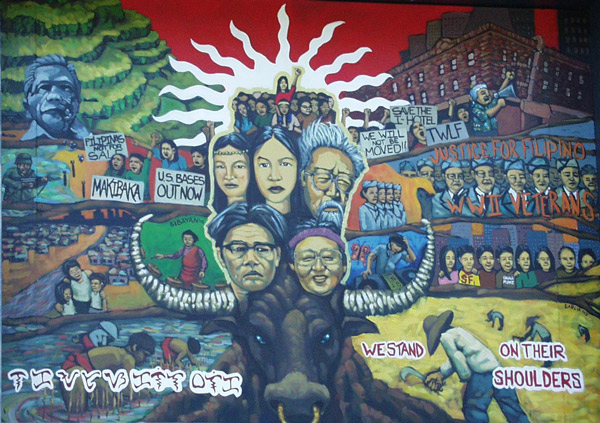
The mural wasn't so hard to find...it's located on the bookstore side of the Cesar Chavez Center. When you face the bookstore, the mural is to your left and it is about two stories off the ground, not at eye level like I thought it would be.

(info below taken from an article on SFSU's website, "Students Unveil Filipino Community Mural" (April 4, 2003):
"SFSU made history today when students unveiled the Filipino Community Mural at the Cesar Chavez Student Center. The mural is the first in the California State University system to depict Filipino history.
The mural is a collaborative effort painted by 200 students, faculty, staff and community members, with lead artists James Garcia and Christina Carpio. It was permanently installed on the north plaza outside the Cesar Chavez Student Center, joining memorials to Cesar E. Chavez, Malcolm X, Rigoberta Menchu, Richard Oakes, Jack Adams and Rosa Parks...

"The mural depicts community, the Filipino struggle for independence, struggles of Filipinos in the United States, solidarity and Filipino history. Planning for the mural began four years ago by a student who wanted to honor Filipinos in the same way other ethnic groups are recognized on campus.
[You can see the sign, "U.S. Bases Out Now" which refers the the "special" relationship between the Philippines and the U.S. due to the 1947 Military Bases Agreement in which post WWII Filipinos in the Philippines were recruited for the U.S. Navy to specifically work as stewards (or glorified servants). Up until th 1970's when ascending the ranks became less discriminatory due to then Chief of Naval Operations Elmo Zumwalt's "Z-Grams", Filipinos, along with blacks and other minorities were relegated to lower ratings.
The sign "Filipinas Not For Sale" makes me a bit angry and emotional. If it weren't for the poor economy of the Philippines, many of these women wouldn't feel forced to work as prostitutes or work away from their homeland as OCW (overseas contract workers). Many women work as domestic help in Europe, the U.S. and in the Middle East. Although their salary is probably more than what they would earn back in the Philippines, these women are really underpaid and sometimes abused or taken advantage of by their employers. In addition, sex trafficking, along with child slavery and prostition is still a big problem in the Philippines.
"Makibaka" was one of the rallying cries during the 1970's; it means "Struggle" in Tagalog. The full phrase was, "Makibaka! Huwag matakot!" (Struggle! Don't be afraid!) and was even made into a song by 1970's Filipino American band (their sound is reminiscent of Santana), Dakila.
You can see San Francisco Filipina American activist, Violet "Bullet" Marasigan, next to the gray haired late poet/community activist Al Robles. At the lower left is labor activist Philip Vera Cruz of the UFW.

(info below taken from SFSU's webpage on "Cesar Chavez Center - Murals"):
"With assistance from over 200 students, faculty and community members, the Filipino Community Mural was dedicated on April 4, 2003 after four years of work.
The mural is divided into four sections: solidarity, community, struggle in the Philippines and struggle in the United States. It represents both ancient times and the ongoing importance placed on community and heritage. “We Stand on their Shoulders” is written in ancient Philippine script at the bottom of the mural to recognize that today’s Filipino community stands tall because of the achievements of their ancestors. [CC's notes: the script is known as "Baybayin"]
In representation of solidarity, a sun rises in the background of the mural, symbolizing the Philippine Revolution against Spanish colonization. The rays of the sun represent the numerous regions that resisted the Spanish domination for almost 400 years. People stand linked arm and arm, in front of the sun, to represent solidarity with all people of color. A Filipino family, the center of the culture’s existence, is also shown.[there are 8 rays in the Philippine sun flag design]
Community, an important part of the Filipino culture, is represented in the mural through important figures Purmassuri, Lorena Barros, Al Robles, Violeta A. Marasigan, and Philip Vera Cruz. These icons of the culture paved the way for future generations through their bravery, dedication and persistent hard work.[Al Robles recently passed away last year. Bert, Superman and I had the pleasure of meeting Alat UCLA in back 1996 for a Filipino American studies conference. His poetry book, "Rappin' With One Thousand Carabao in the Dark" was released that year and I had him sign my copy.]
The struggle in the Philippines is a component of the mural so that the Filipino-American community will not overlook it today. A carabao, a water buffalo, represents the Filipino people who are tillers of the land. Peasants are shown to represent those who continue to struggle for the rights of their lands. An image of a woman playing Kulintang emphasizes importance of music in the Filipino indigenous culture, and students and workers are shown fighting for a dignified way of life.
The right side of the mural shows the struggle in the United States through pictures of struggle from the Filipino-American community. The top image is of the International Hotel and those displaced through eviction. Veterans and nurses are shown to represent the struggle for equality and fair pay. The DJ, balancing out the women playing Kulintang, and the SF State students represent the life and trial of the young Filipino-American culture. Lastly, the farm workers are shown planting the seeds from which the roots of the community are grown.

Below the mural are the windows/doors to the bookstore. Everything that had the SFSU logo on it was 25% off that day, so hell to the yeah, I bought a shirt (Go Gators!) to wear on College T-Shirt Fridays for work. Actually, my shirt is so cool - it says, "SFSU - The School that Rocks!" with a kickass guitar and flames right in the middle of the shirt!
To view a larger version of the mural click here. (btw, not my photo)
For more info on this mural and the others at the Cesar Chavez Center, click here.


No comments:
Post a Comment