"Ride the Lightning" (full album) - Metallica

Showing posts with label library. Show all posts

Wednesday, September 23, 2015

Another Library yarn bombed! North Park Public Library

As TC and I walked along North Park Way, I admired the font...

gracing the side of the North Park Library. Right we we got to the corner, we both noticed the familiar cozy wrappings adorning the trees in front of the library...

Sunday, September 20, 2015

Living Room Cafe @ The SD Central Library

Bert and I originally planned to have coffee at Bean Bar across the street from the SD Central Library...

Unfortunately, it was already closed by 5:30 pm, then I remembered that the library had a cafe there...

Sunday, November 14, 2010

The SF Public Library - Part 2 - "Black and Brown Images", "Filipinos in San Francisco" and the Filipino American Center

So we went upstairs to the third floor where there is a portion dedicated to the Filipino American Center. Wow, they actually have a section like this here! That is pretty damn cool. Thane actually went here when they opened up the reading room back in 196, right after the new library opened.

Together, with Singgalot, the 3rd Floor's exhibits were perfect for the theme of Filipino American History month. Whenever we travel, I like to throw in some historical aspect for our trips. I guess this wouldn't work for North Dakota, BF Montana or Vermont. So, this tactic usually works in areas with a high concentration of Filipino Americans like San Francisco.

Along with Singgalot downstairs, the 3rd Floor had this exhibit, "Black and Brown Images" featuring editorial cartoons from the turn of the century. This exhibit graphically and painfully illustrate how Americans viewed the Philippines during the Philippine American War (1899-1902). The exhibit goes hand in hand with "The Forbidden Book" written by Abe Ignacio, Enrique de la Cruz, Jorge Emanuel, and the late Helen Toribio (Abe's wife; she died of cancer at age 50 in 2004). The accompanying exhibit made the rounds, reaching San Diego back in Summer of 2003. TC was still a toddler. Helen was still alive and Bert and I had the great opportunity to meet her when she presented a lecture at the San Diego Historical Society in Balboa Park. I'd admired her work in her book she edited, "Seven Card Stud and Seven Manangs Wild" as well as her articles on the KDP (The Katipunan ng Demoktratikong Pilipino or "The Union of Democratic Filipinos"anti-martial law organization in the 70's).

The "Black and Brown Images" traveling exhibit was shown at Springfield College, a really small independent schoo in the Rolando area of San Diego. We also saw the exhibit back in 2002 at the FANHS National Conference in Los Angeles, where it made it's debut and the book was still in the works.

Here are some book reviews of "The Forbidden Book":
Politcal Review
"Uncovering the Forbidden Truth" from Bulatlat.com
and Our Own Voice blog

This cover of Judge (a popular magazine in the early 1900's) depicts President McKinley holding a naked savage (the Filipino), about to dip him into the river. The caption is, "Oh you dirty boy!".

Images such as these gave rise to stereotypes that Filipinos were incapable of taking care of themselves. They were depicted as "blacks" or "googoos" (racial stereotypes) as well as "childlike".  Hence, justifying the U.S. domination and colonization of the islands beginning in 1898. Although the Philippines had just fought the Philippine Spanish Revolution in 1896 and plunged into the Philippine American War a few years later (called, "The Philippine Insurrection" in the WHITE history books), and getting sold off by first colonial master Spain to the U.S. for $20 million, many Americans in the U.S. knew little of the people of this distant island nation.

Although the more wealthy and fortunate were chosen to be pensionados (government funded students sent to the U.S.), hundreds of tribal Filipinos were shipped off to the cold climes of St. Louis and displayed like animals at the St. Louis World Fair in 1904. Americans saw these Filipinos, some of which were bonafide headhunters, wore little clothing, etc, and walked away with these images seared into their brain that Filipinos were primitive people, had "tails", and ate "dogs".

At the same time, the nation was being forcefed the American educational system under the guise of "Benevolent Assimilation". Teaching English and making it the lingua franca was one way the colonizer could teach their subjects and indoctrinate them.  Andres Bonifacio = bad. Abraham Lincoln = good. Learn about foreign concepts like snow. Learn about apples which don't grow in the Philippines. Denigrate the national heroes and learn about American ones instead. The U.S. taught the Filipinos about democracy, yet also denied them the same benefit and suppressed their national identity through "Benevolent Assimilation".

I didn't take a lot of photos of the exhibit because I didn't want to call too much attention to myself. Many of the displayed images are in the book and were arranged thematically. Lots of drawings of Uncle Sam and Filipinos depicted as savages. There is a famous one of American soldiers pointing their rifles at blindfolded young boys with the caption, "Kill Everyone Over 10", an actual order by General Jacob Smith.

In addition to the "Black and Brown Images" exhibit, they also had a preview to the book "Filipinos in San Francisco" (Arcadia Publishing). In fact, my friend that I met earlier during lunch is a part of this book and was happy to hear that our chapter got our book out ("Filipinos in San Diego") earlier this year. If I had known I would bump into him, I would have brought my copy so that he could look at it. Eduardo Datangel is the head of T'Boli Publishing House and formerly of Arkipelago Books (back in the mid 90's). He is the President of the FANHS, San Francisco Chapter.

Preview of photos of the upcoming book...


The last part of our visit to the third floor was this, the  Filipino American Center, which is actually a small room filled with books on Philippine and Filipino American history, poetry, language, literature, etc. You name it, and it's there. I collect a lot of books myself (but I mainly focus on the Filipino American aspect) and this collection kicks a$$ on mine. They also had a variety of periodicals  (magazines, newspapers, etc). In the middle of the room is a large table lined with chairs if one wanted to sit down and read. I didn't take a photo of the room because there were people sitting there already and reading. They didn't even look up when we walked in there. In any case, I felt a bit intrusive so i didn't snap any shots of the room.

I like that big wooden carving.  Where's the Barrel Man?

More on "Black and Brown Images" here, as well as the SF Public Library's connection to Filipino American history here...

We needed a break before heading over to the Mission. We promised TC that we'd go to the small park across the street...

Saturday, November 13, 2010

The SF Public Library - Part 1 "Singgalot: The Ties That Bind" Exhibit

The Smithsonian traveling exhibit "Singgalot - The Ties that Bind" was one of the main reasons that I booked our trip to SF. Call me a history nerd or whatever TF, but I knew that we couldn't miss this opportunity. This was the last West Coast showing until October 24th. This is new Main Library which opened in 1996; the previous library was damaged in 1989 in the Loma Prieto quake and then rebuilt as the new Asian Art Museum.

This exhibit was supposed to be in San Diego during the Summer of 2008 at the New Americans Museum in Liberty Station (I'll always call it the "old NTC") in Point Loma. "Singgalot" was eventually shown at Remy's on Temple on Temple Street in Hi-Fi (Historic Filipino Town in Los Angeles) that summer. Due to the bad economy, the New Americans Museum went dark and never reopened which was a shame as they had several worthy cultural exhibits prior to the booking of Singgalot . So, here it was in good ole SF and it was free too!

The gallery was downstairs but when we got there, it was dark. WTF!

In the meantime, Thane took this visit as an opportunity to renew his library card. Why not, eh? Turns out that someone forgot to open the exhibit doors. I was kind of irritated because the exhibit was supposed to be open at 11 am and it was already 1 pm. Anyhow, shortly after trekking back upstairs to inform them that the room was closed, they got someone to open it up.

This paneled lightbox shows a portion of Eliseo Art Silva's Filipino American History Mural, "Gintong Kasaysayan, Gintong Pamang" (A Glorious History, A Glorious Legacy) which is off the 101 and Beverly Blvd in Hi-Fi. See our visit to the mural here! The man in the middle is UFW labor leader and activist Phillip Veracruz and diagonally below him, another UFW leader, Larry Itliong. It was Itliong who was leader of the Filipino led AWOC who convinced Cesar Chavez (pictured holding a picket sign in the lower left) and the Mexican farmworkers of the NFW to join forces for the Delano Grape Strike in 1965. This strike became one of the most successful in labor history. Unfortunately, Filipinos get shafted by the history books and give credit to the Mexican faction when Filipinos should be equally recognized for their efforts in the agricultural development of the West Coast.

"At over 376,000 square feet (34,900 m2) and with six floors above ground and one below, the new library is more than twice as big as the building it replaced. The new library features over 300 computer terminals, room for 1100 laptops, and a new wing for children." (info from wikipedia's entry on the SF Public Library)

There was also a side exhibit, "Baha" featuring paintings by Bren Bataclan.


After snapping a couple of shots, I saw the sign that photography wasn't allowed so I put away my camera like a good little girl should. Although I was sorely tempted! There were more panels behind this one, which was in the very front. The exhibit was an excelled overview of the contributions Filipinos have made since immigrating to the United States at the turn of the 20th century.

(info taken from the Smithsonian site's itinerary on Singgalot)

"Today there are more than 2.5 million Filipino Americans in the U.S. Yet many, including Filipinos themselves, aren't familiar with the details of their history in America: their experiences, rich traditions, and culture. Singgalot is their story.

After tracing the first trans-oceanic trade missions between Manila and Acapulco in the 1500s, Singgalot explores the tenuous political relationship between the United States and the Philippines, when Spain ceded the Pacific-island following the Spanish-American War. Rarely seen historical images detail Filipino migration between 1906 and 1935 as Hawai’i sugar plantations, West Coast farms, and Alaskan canneries recruited Asians to join the labor force. When the U.S. government sounded the call to arms in the 1940s, Filipino immigrants answered, serving as infantrymen and earning respect from a grateful nation. Nearly 20 years later, the 1965 Immigration Act hastened a third major wave of Filipinos who would champion major changes in gender equality and class in the Filipino American community and make significant contributions to the fight for civil rights."

Some of the poignant images were the eldery Filipino American veterans fighting for their rights. On a side not, did you know that Congressman Bob Filner got arrested in Washington DC in the late 90's fighting for the equity of the Filipino American veterans? It was for civil disobedience. I believe he chained himself to a fence along with other veterans in front of the White House. How's that for dedication to a cause? 

There were photos of smiling War Brides who joined their Filipino soldier husbands to American to establish homes and communities all over the U.S., particularly in Navy Towns. For example, in San Diego, many of those pioneer families settled in Southeast San Diego due to restrictive covenants. We saw images of the Manongs who worked as field hands all over the coast picking fruits and vegetables (doing the jobs that Latinos now do), as well as Alaskeros who worked in the fishing and canning industries of Alaska. Pensionados, government funded students were also depicted, many in  formal three piece suits. In San Diego, there were several documentations of pensionados attending Coronado High School and San Diego Normal School (now known as San Diego State University, "normal" denoted that it was a teacher training college). Sakadas wearing their bango tags were also shown. Many of the Sakadas were recruited specifically from the Ilocos Norte region in the Philippines to work in the pineapple and sugar cane plantations in Hawaii; they were the latest ethnic group to supplant striking Japanese and Chinese field laborers.

I'm glad that we had a chance to see this. Even though the information isn't new to me, Bert or Thane, I wanted TC to see this firsthand. As a young toddler and young child, she would accompany me during my Filipino American history workshop presentations. She's heard this information before. She's seen my powerpoint and handout. But this was bigger, bolder, and much more tangible than hearing her mom go on and on about Filipino American history. She's older now and understands it more and can make the connections to the past to the present.

Here are a couple of  links on the exhibit:
Images
Related Publications

After this - we headed to the third floor to see a few more exhibits at the Filipino American Center.

Friday, July 16, 2010

Toronto Public Library - Lillian H. Smith Branch

OMG, air conditioning here we come! What better place to relax than a library? I just realized we've also visited another library from a past trip (Portland's Multonomah Public Library). We were walking down College Street to get back to our hotel and it was calling our name. Plus, we like hanging out where the locals bookworms hang out.
This was the Lillian H. Smith branch of the Toronto Public Library, the largest public library system in North America.
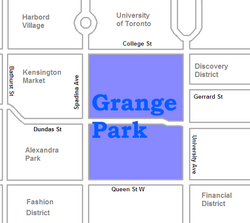
It is located the Grange Park neighborhood which gets its name from the local park. There is also a mansion called "The Grange" there. When I see that word "grange", I think of that ZZ Top song, "La Grange" ("They gotta lotta nice girls hehh!").

From wikipedia's entry on "Grange Park":

"Grange Park is a mixed, but predominantly residential neighbourhood. The residential stock varies from working men's cottages built in the 1800s to semi-detached homes to mansions. Many of the buildings have been converted to commercial use, including art galleries within the vicinity of the Art Gallery of Ontario, restaurants and offices. Many of the homes are rented to students of the Ontario College of Art & Design, located on McCaul Street, and the University of Toronto, located to the north."
(Map from Wikipedia, "Grange Park")

The Lillian H. Smith  branch of the Toronto public library was originally the location for the Boys and Girls House; Lillian H. Smith was its founder.  This branch's focus was on children's literature.
It was nice resting in room with AC on full blast. In the Children's Section, Bert kicked back and rested his eyes while TC leafed through a few teeny bopper magazines (looking at articles on the helmet haired femmebot Justin Bieber, no doubt), while I lay back in a chair and stretched my agonized legs and feet.
One of the statues flanking the entrance:
As Snoop Dogg would say, "So just chill...'til the next episode!"